
The Last Martini
a short story
Last night I dreamt about the end of the world.
My husband and I rescued a baby elephant from an abandoned zoo, and cared for her in a Hollywood Hills mansion that had been owned by a music producer — so it wasn’t all bad.
Raising the elephant was the most meaningful thing we had ever done. We didn’t know if there were any others left, so we treated Bernice like the last of her kind.
We loved her, and she absolutely loved the swimming pool. It was one of those zero-edge masterpieces, and she would just float, bobbing along with her trunk draped over the side, not a care in the world. Luckily the masterpiece had a top-of-the-line salt-water generator, so we raided Home Depot for dozens of bags of salt and thought we could probably keep the thing going until 2075.
Fresh food was a challenge, but we learned to terrace farm on the hillside there. Bernice loved vegetables. Loved them. We could hardly grow them fast enough. I worried about what would happen when she got bigger.
But if I had learned anything, it was the pointlessness of worrying. I had gotten skilled at catching myself doing it, and then letting it go. We had realized in a profound way that not much we had worried about came true, and everything we had never thought of was a serious problem. Most adults know this in some way already, but it had been hard for the concept to fully take hold during the Before-Times.
Our days looked like this: wake up, make coffee, stare outside at the masterpiece. Get Bernice up and feed her. Then there were countless chores, discussions, jokes about survival. Get in the pool, float around. More chores, work, maintenance and jokes about maintenance. We were pretty happy.
It had taken us a long time to get happy, though. After The Event, there was a sharp cycle of grief and fear, and drinking. Lots of drinking. At first, we had so many bottles to choose from! I had a month where I drank Cristal for breakfast every day. Eventually all the nearby booze dwindled, so we had to save it for special occasions.
We found Bernice around that time, so cutting back on alcohol became surprisingly easy; we decided to live for her. She also hated it when we drank. She would take that strong trunk of hers and reach for your cocktail glass, and bat at your mouth and hands. It was playful, but she clearly thought getting drunk was a bad idea. “Drunk trunk,” we used to call it. “Let’s have a drink on the small balcony so we don’t get hit by drunk trunk!”
We saw people, but it was very, very rarely, and it was usually a hugging-and-crying type situation. I’m happy to report that there were no zombies, and no roving bands of outlaws. At least in our area, there were few survivors, and at present we all had enough stuff to keep going. People were too sad to fight. We had lost so much already.
Sometimes we traded our vegetables, but usually we just gave them away when we saw a human. We did have to protect the veg from animals, but Bernice helped us with that. She would sense when they were near the crop, and make a swooping sign with her trunk for birds or a tapping on the ground for rodents. Once there was a coyote and she started banging on the wall, but I didn’t know what she was saying. I’ll know for next time.
Raising Bernice caused my husband to become more calm and philosophical. The rat-race hadn’t been for him, and finding this rhythm of farming, resting and enjoying our bond with a rare creature made him happy. I got to do a lot of things I had always wanted. Besides raising an elephant, I was writing and making art. I often toured nearby empty mansions and picked out furniture to redecorate our house. I would still have to convince my husband that getting whatever it was was a good idea — for example the XXL Roche Bobois Mah Jong Sofa was worth moving out of the starlet’s house — “It would look soooo amazing right here, though!” I would say. Instead of money, objects were measured in effort.
But the clothes were easy to move. Ohhhh the clothes. Things I could never afford before. Halston! Vivienne Westwood! Alexander McQueen! I wore the most magnificent things to nowhere in particular. Sometimes that made me sad, but mostly, I enjoyed the beauty of our collective creative past. Plus, I didn’t know how to sew, and who knew if such things would ever be made again.
We enjoyed fantasizing about making a trip to a faraway art museum, or to the Redwoods. But we had Bernice. We had everything we needed, and fear of missing out slowly became a bygone emotion.
Before Bernice, we would go on big excursions to find different food and cool stuff, and that’s how we found her. Somehow, we spotted the tip of her trunk peeking out of a fence. She had gotten out of her enclosure, and was roaming around the main part of the park. We were able to break in, and I think she was hungry and thirsty, because she came straight up to us and wanted to leave together. She didn’t like when we started looking around the zoo for others.
We didn’t find any other animals alive, but after loading Bernice into the back of the pickup, we ran into Bob. He was kind and extremely smart, and had a setup nearby that he told us about excitedly. He wanted us to go and see it — a big warehouse full of electronics that he was using to try to get information about other places and how they were faring. He said he heard rumbles from overseas. I think we would have gone with him if it hadn’t been for Bernice, because we were curious and thought he would be a good contact. We traded information and went on our way, and didn’t see him again for many months.
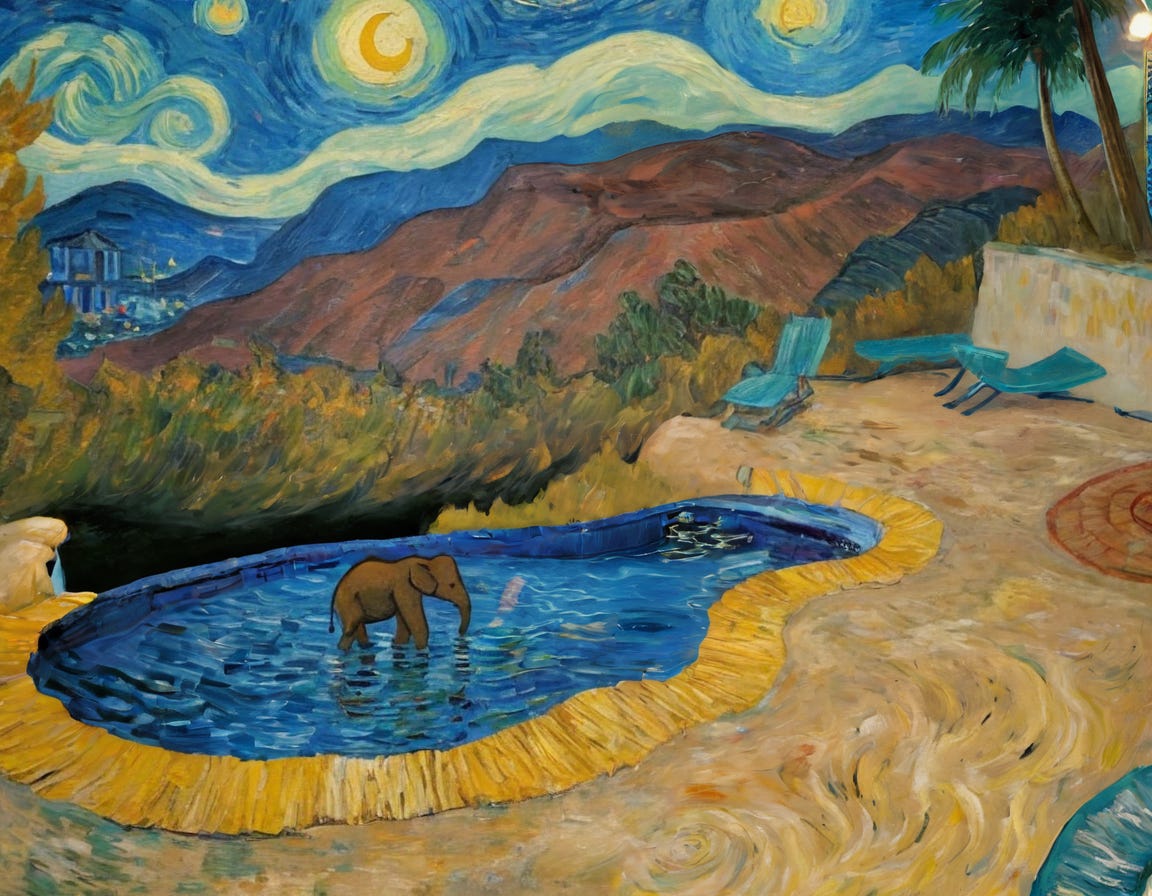
Bob was quite sweaty when we saw him again, having climbed up our big hill; I’m not really sure why he didn’t have a vehicle, thankfully L.A. had gone mostly solar by the time of The Event. We offered him water and a dip in the pool, which he accepted graciously.
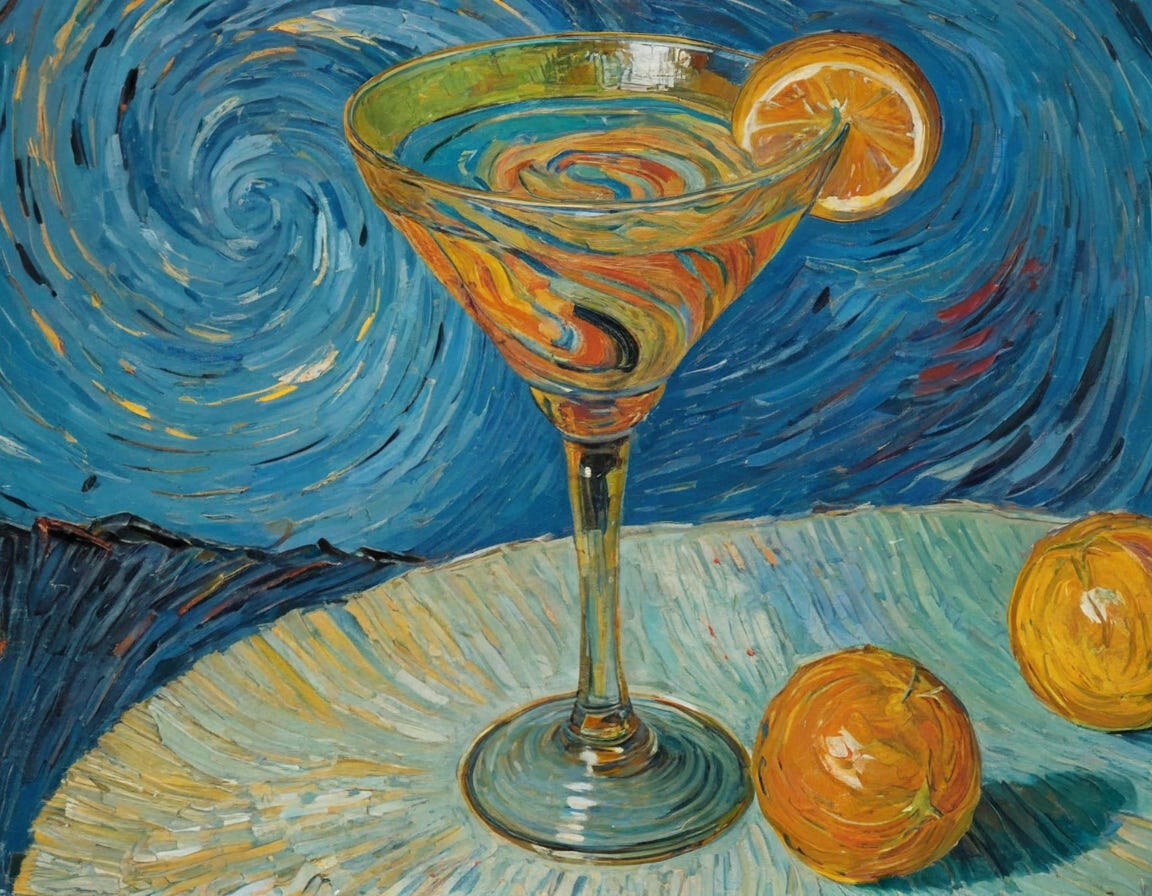
Then we had drinks and he told us what he had learned. Other places were not as quiet as L.A., and there was unrest abroad. He said other countries blamed the U.S. for The Event, and they had been threatening to nuke us. He didn’t think they had “the capability … yet,” he said, sipping his martini and blocking some good-natured pokes from Bernice. The reactors were not operational, according to what he understood. He seemed shaken though and had come to warn us.
It was a lot to take in. It seemed unreal, but after what we’d survived, plausible. My husband said quietly and almost to himself, “What are we supposed to do with this information?” Just like last time, there was nothing we could do. But unlike last time, we were intimate with death. We knew its shadow and how it had slowly casted light on our lives.
Bob stayed the night and left in the morning. There were hugs and tears. Bernice tickled his ear. We went back to chores and maintenance, but there were no jokes. Bernice tried to make us laugh through various shenanigans. Eventually, things went back to normal.
Then, one afternoon, a young woman we had never met rode a Triumph motorcycle up the dusty road and into our driveway. She introduced herself as Yolanda, a friend of Bob’s. “He’s busy trying to help facilitate last-minute negotiations,” she said. “But it doesn’t look good.”
She told us that a nuclear attack was promised at 8 p.m. tonight. Bob, who treasured knowledge, felt it was important for us to know. “He said, if it happens, no one will survive. There’s no point in trying to run or hide,” Yolanda reported. She hugged us, and got on her bike and drove away. I stared at the vegetables.
Just before sunset, we raided the pantry and the garden. We played Aretha Franklin and set ourselves up on the big Mah Jong sofa in front of the infinity pool. We poured martinis and gave Bernice as many vegetables as her great, big heart desired. Maybe it was because she was busy eating, but she didn’t try to bat away our drinks.
We talked about how weird it was to potentially be the last people on earth. All of the generations who came before us, the hundreds of thousands of years of humanity and the billions of humans. How could we be so lucky to sit here with Bernice and watch the end? It was a one in a million chance — like being a Mozart, or a Billie Holiday. It was like walking on the moon or dancing like Baryshnikov. It was such a gift, an honor to attend. And I got to wear Valentino.
As the sun set, we talked about the centuries of humans who had suffered in life and in death, lighting candles for them, including so many of our loved ones whom we missed. We talked about how fortunate we were to survive The Event, if only so we could tend our garden and care for Bernice. She nuzzled us, and then sat on the low, brightly patterned ottoman with her carrot.
We looked out at the hills and felt lucky to have the chance to say goodbye to the earth and to leave human life together as a family — painlessly and in the blink of an eye — returning to the stars in unison.
Oh my God, I love this so much! So creative, beautiful yet disturbing. I want more of this.